I discovered Japan through the movies. I grew up in New York City in the 1970’s and 80’s. It was a great time for movies and moviegoers. In high school, I discovered "rerun" movie houses. Theatre 80 was my favorite. A double feature was around $5. They had a little café where you could get wired before and between shows. Theatre 80 was tiny. You had to sit in the back row, which was the only one with legroom other than the front. I imagine the screen being about 20 feet from the back row. They showed really old movies. Then there was Cinema Village, which is still running, and Thalia SoHo on Vandam and on the Upper West Side, which are both gone. Film Forum endures, almost exactly as it was, which is a blessing.
I never studied Japanese film in school, but I have probably seen more than 50 Japanese movies. In Japanese film criticism, there is a discussion about which director, Yasujiro Ozu or Akira Kurosawa, captures Japanese people and culture more accurately. Japanese movies have given me, and anyone who watches them, such a deep education about Japanese history, people, and culture. Ozu and Kurosawa have just acted as trustworthy guides, two starting points and references from which I have been able to explore.
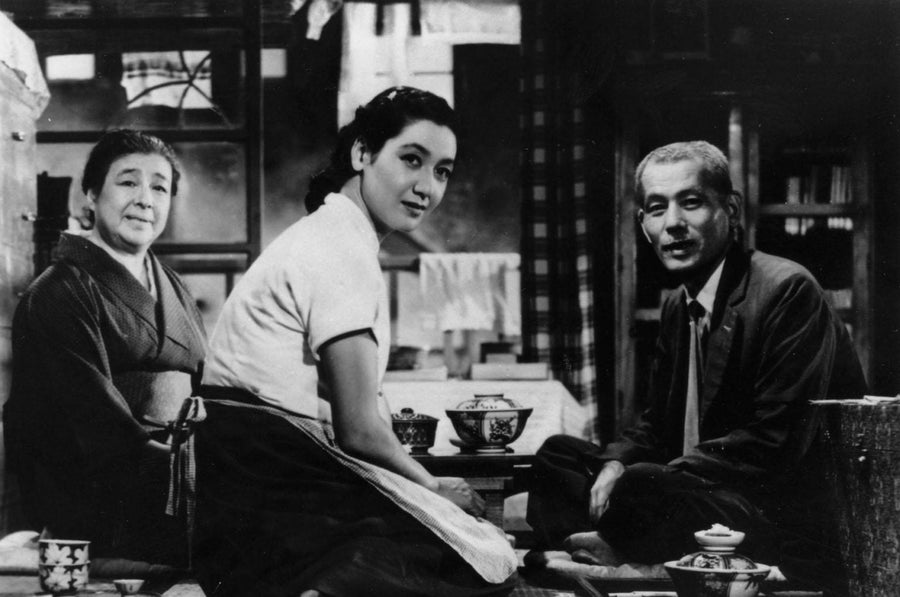
If I had to start with either director or any one movie, I could only begin with Ozu’s "Tokyo Story," made in 1953. It is the most intimate movie I have ever seen. Setsuko Hara’s performance is so natural, charming, and moving. Chishu Ryu is measured and thoughtful. Both actors appear in other Ozu movies, but "Tokyo Story" is such a magical collaboration. Getting back to the discussion of Ozu and Kurosawa, I would say that Ozu shares Japanese sensitivity and sensibility. When I was at my best with my Japanese, I could understand Japanese and express myself in indirect ways. Ozu captures relationships as rich, layered, and emotional, with many things left unsaid, implied, or indirectly stated. This has changed to some extent but it is still a part of communication. Ozu and Kurosawa also examine change—in Japanese society due to industrialization and modernization, and in people’s lives as they experience loss, connection, sadness, joy, and self-understanding.

Yasujiro Ozu's "Tokyo Story," from left to right: Chieko Higashiyama (as Tomi Hirayama), Setsuko Hara (as Noriko Hirayama), and Chishu Ryu (as Shukichi Hirayama).
Kurosawa is no less of a student and teacher about Japanese culture, people, history, and society. I have many memories and images from Kurosawa movies. The pouring rain at the beginning of "Rashomon" has been documented because of the lengths the production crew went through to pull it off. I now see it as Kurosawa’s stamp—brash, inescapable, high contrast. He is known for his samurai and war movies, but he also sets films in everyday life. Like Ozu, he contemplates the changes in Japanese culture and society. Ozu reflects on these changes with intimate, personal stories. Kurosawa attacks these questions. His characters go to the brink. They fight, then crumple to the ground in despair and exhaustion. Ozu captures loyalty, care, and moral nobility in intimate ways. Kurosawa conveys these qualities in bold strokes.

Opening Scene of Akira Kurosawa's "Rashomon."
If I had to choose a Kurosawa movie to start with, I would say "Kagemusha" (The Shadow Warrior). The opening scene is mind-blowing. You'll have to see why. After that, I'd say "Ran," his version of "King Lear." I also love "Ikiru" (To Live), which was remade in 2022 as "Living" with a screenplay by Kazuo Ishiguro. Bill Nighy plays the main character. It got a lot of attention and I believe it won several awards. "Dreams" does not get a lot of attention but it's one of his best and last films. As for Ozu, I've loved every one of his "seasonal" films. I believe "Early Spring" was a favorite, and I know I enjoyed "Late Autumn."
In working on the branding of Shokuya with Jarin Moriguchi, our Design Director, we explored many Japanese designs, colors, and styles. We considered a more subtle and natural color palette that is found in Japanese dyeing, but, ultimately, we went with the bolder colors of kimono and Kabuki. "Mishima: A Life in Four Chapters" was a main inspiration. "Mishima" made it into theatres last year while celebrating its 40th anniversary. There are different story lines, time frames, and senses of reality. The storyline that captures his entry into adulthood is told in bright, vibrant colors. We were inspired by these. The production was also a Japanese American collaboration. Paul Schrader, who wrote "Taxi Driver," directed it and co-wrote it with his brother Leonard Schrader and his wife, Chieko Schrader. The music by Philip Glass is one of the best movie scores ever. The film was made by a predominantly Japanese crew, shot in Japan, in Japanese, with Japanese actors. Postproduction was also a Japanese American collaboration.

From Paul Schrader's "Mishima: A Life in Four Chapters," Go Riju (as young adult Yukio Mishima).
I could and should talk about other directors and other movies, but, again, these two are the most intensely debated and gave me an incredible entryway. I am also a big fan of Takeshi Kitano, Beat Takeshi. As violent as Kitano’s movies are, I love them. I also appreciate that he is also a comedian. You can somehow see this in his performances as a yakuza crime boss. I don’t know if the dialect in his movies is Yakuza, "Kansai-ben," or a combination, but I love hearing it and wish I could speak it myself. It’s probably safer that I don’t.
So, how did it all begin? To quote Pauline Kael, "I lost it at the movies."